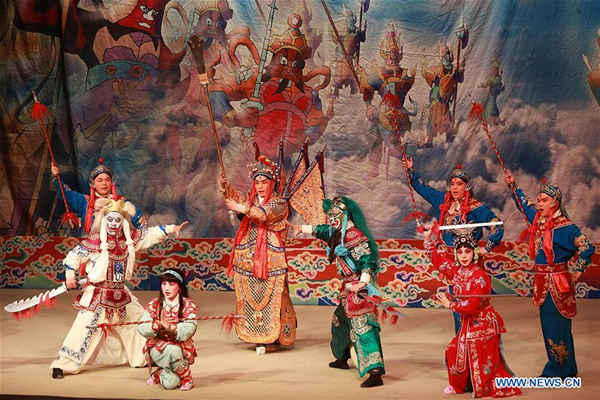
Peking Opera
Overview
Peking Opera, also known as "jingju" in Chinese, is a widely recognized element of China's cultural heritage, celebrated for its unique combination of music, vocal performance, mime and acrobatics.
Established around the late 18th century, Peking Opera integrates various elements such as singing, acting, acrobatics and martial arts. It uses the Beijing dialect of Chinese to tell stories that encapsulate history, politics, society and daily life, aiming to both educate and entertain. The form is characterized by elaborate costumes, distinct makeup patterns, and a strict system of symbolic gestures and movements that convey specific meanings.
Historical Context
In 1790, when four Hui Opera troupes visited Beijing as part of celebrations for the 80th birthday of Emperor Qianlong (1711-99), they stayed in the south of the city. Hui Opera, or huiju, a form of opera from Anhui province, provided the foundations of Peking Opera.
In about 1840, Peking Opera began to formally take shape, growing rapidly during the time of Empress Dowager Cixi (1835-1908), a Chinese opera lover. The art form went from strength to strength, with troupes being formed in Beijing, Tianjin and Shanghai. Peking Opera had its heyday in the 1920s and 1930s, with star performers popularizing the art form across the country and abroad.
Music and Performance
Peking Opera music is characterized by two primary styles: "xīpí" and "èrhuáng". These styles encompass arias, fixed-tune melodies and percussion patterns that are fundamental to creating the distinct atmosphere of Peking Opera. The performances are divided into four main role categories: Sheng (male role), Dan (female role), Jing (painted-face male role) and Chou (clown). Each role requires specialized skills and embodies specific character types and personalities.
Global Recognition
Over the years, Peking Opera has grown beyond China, gaining international recognition. In 2010, it was listed as an Intangible Cultural Heritage of Humanity by UNESCO. This recognition has further fueled efforts to preserve and promote Peking Opera globally.
Modern Adaptations and Popularity
Despite facing challenges from modern entertainment forms, Peking Opera continues to adapt and thrive. Innovative programs, such as TV shows and performances that blend traditional opera with contemporary elements, aim to introduce this art form to younger audiences worldwide.
Programs like the Beijing TV Station's "Legacy of China" showcase celebrities learning Peking Opera from established masters, thus broadening its appeal. Additionally, the infusion of Peking Opera elements into modern music and arts has helped sustain its relevance and popularity among newer generations.
Educational and Cultural Initiatives
Efforts to promote Peking Opera extend to educational settings, where schools incorporate Peking Opera into their curricula, allowing students to engage with this traditional art form.
Community centers and cultural exhibitions worldwide contribute to raising awareness and appreciation of Peking Opera, ensuring that this invaluable cultural asset is passed down to future generations.
The continued interest and support from educational institutions and cultural organizations reflect a commitment to preserving the rich legacy of Peking Opera as a vital part of China's cultural heritage. Article reference1. 10 masterpieces in traditional Peking Opera repertoire. chinadaily.com.cn. 20172. Peking Opera: Inheritance or popularization?. chinadaily.com.cn. 20183. Head over heels for Peking Opera. chinadaily.com.cn. 20234. Peking opera meets Italian opera. chinadaily.com.cn. 20235. Peking Opera pitched to younger audiences. chinadaily.com.cn. 2022ExpandPhoto Gallery(56 pictures)CategoriesArtsTagOpera and DramaIntangible Cultural Heritage of Humanity in ChinaIntangible Cultural HeritageRelatedLin ChongSong JiangShi Nai'anLuo GuanzhongCatalogue1. Overview2. Historical Context3. Music and Performance4. Global Recognition5. Modern Adaptations and Popularity6. Educational and Cultural Initiatives- - - []








